There are three very important advantages of carpooling, that aren’t usually taken into consideration by transport planners:
1.- The hourly distribution of most of our trips.
2.- The huge amount of the new capacity brought in by carpooling.
3.- The door to door advantage of carpooling.
1 Hourly distribution of travels
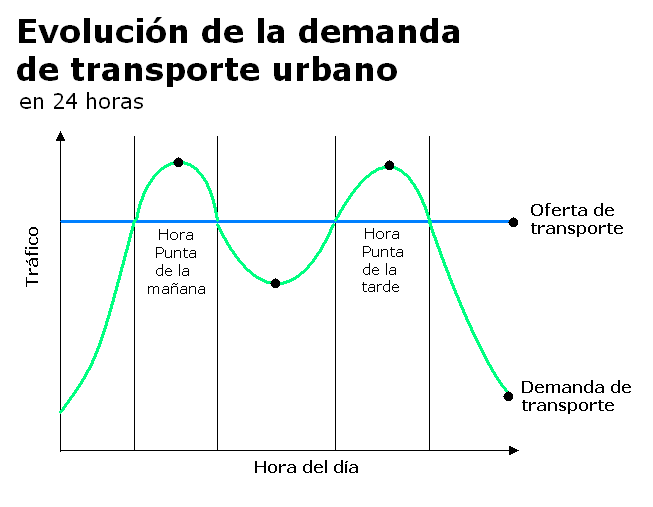
Traffic jams and public transport congestion doesn’t happen all day long. But this only happens at the peak times, when most of us have to go at about the same time to work, and then back home.
Because at that time there is such a high peak on transport seats demand (even bigger than 15 tone buses can cope with). And we also try to put on the roads and city streets some more vehicles than roads can admit without collapsing (just because most of them are underutilized and waste 4 empty seats per trip).
Taking this hourly distribution into consideration, we can see that carpooling is not an enemy nor competition of public transportation, but an ally.
Because carpooling is easy only at peak hour (when there is such a rush of people demanding transportation). Due to so many people moving at the same time in all directions, only then new carpooling apps can almost always find several of them going in the same direction, and being compatible to go together.
These circumstances don’t happen all day long, and the rest of the day public transport will keep the current number of travellers.
Only the excess demand during peak hours will be removed from public transport, which causes congestion and poor service at those times.
Don’t be afraid. Carpooling will not steal customers to public transit but at peak time, when it is saturated and does not cope for the peak of transport demand.
So, with the aid of carpooling buses will no longer need to be that big, and fleets could be dimensioned for a smoother hourly demand (a flatter curve, without the former peaks at the times to go to work and back home). This way, new smaller buses will be efficient, economical to operate and sustainable all day long (and not only at peak time, when people complain because they are saturated).
And such former big buses will no longer go round and round wasting so many empty seats for many more hours during the rest of the day.
2 The huge amount of the new capacity brought in by carpooling.
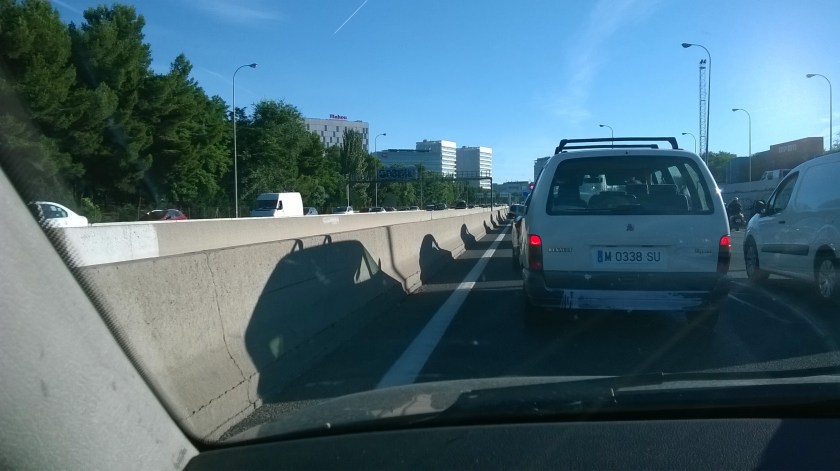
The huge amount of the new capacity brought in by carpooling has the ability to convert millions of wasted empty car seats into new collective transportation seats, just when they are most needed.
So much, that by carrying the same people in half the number of cars, finally no BUS nor HOV lanes will be required.
Statistics tell us that cars circulating in any major city are currently wasting more vacant seats than commuters on the subway and buses combined.
Each car that shares its four free seats while its driver is commuting to work has the potential to take four other cars out of traffic (those of those who switch to riding as passengers, even if only to share expenses and save more than half, or to avoid parking problems at work, or to collectively reduce traffic jams and pollution).
Furthermore, most of these free seats will be available precisely when they are most needed (during rush hour, when most of us need to get to and from work).
Surveys (except for the one I know of in my country) agree in their conclusions: «6 out of 10 Spaniards would share a car daily to save money.» And data from those interested in riding as passengers in the car of a driver who offers free seats in their car and is traveling in the same direction indicates that the average occupancy of these vehicles will be three people per trip, achieving cost savings of over 50%.
This is so true that it is estimated that sharing between 15 and 20% of the number of cars (which currently carry only the driver) will be enough to end rush-hour traffic jams, or at least greatly reduce the problem they pose.
And the effects on pollution are cumulative: In addition to the same number of people travelling in fewer cars, there are also other indirect effects, such as fewer turns looking for parking, and preventing vehicles stuck in rush-hour traffic jams from consuming and polluting up to 80% more than normal (according to studies by Dr. Martin Treiber of the University of Dresden).
Taking all these effects into account, it is estimated that, thanks to carpooling, a large city the size of Madrid could reduce its CO2 emissions by up to one million tons per year.
The appropriateness of implementing bus lanes or high-occupancy vehicle lanes is a controversial debate.
Some advocate introducing them (in the vain hope that by slowing down private cars, people will switch to public transportation, and without considering that public transportation is already overcrowded during rush hour).
But these dedicated lanes are typically created by taking away a lane from most vehicles, which ends up worsening rush-hour traffic jams.
However, the reduction in car traffic achieved with carpooling is such that traffic automatically flows smoothly for all vehicles (even buses), making dedicated lanes unnecessary. And even less so for these to be separated by barricades, which causes significant damage if the planner fails to correctly design the necessary layout (which, moreover, often varies greatly depending on the time of day, and even the day of the week, or the season).
3 The door to door advantage of carpooling.

No matter how hard we try, we will never achieve a voluntary transfer of travellers from cars to public transport (unless dogmatists biased by certain ideologically preconceived solutions force them to do so against their will). Because people will only switch to a mode that offers them advantages, such as reduced travel time or greater convenience.
Experiences like the one in Tallinn show that it’s not enough to simply give away the cost of a public transport ticket, because our main concern isn’t the cost (but the time lost on the journey).
People will never switch from driving to public transport, or cycling, simply because it would take longer.
Public transport is based on the concept of lines.
So, everyone who isn’t lucky enough to have their home and work on the same line will have to make transfers, and this (coupled with the frequent stops public transport makes to pick up and drop off passengers) will inevitably make them take longer.
It takes even up to three or four times longer than if they could go directly from door to door, as happens when we travel in our private cars.
However, the magic of carpooling is that many more people can travel quickly and comfortably by car, without each having to take their own car; instead, they can take advantage of the vacant seats that used to be wasted by other cars travelling in the same direction.
Many more travellers can enjoy going virtually door-to-door (without wasting time transferring between public transportation lines), but in far fewer cars than before, and with efficiency and sustainability similar to those of public transportation (because more people travel in fewer cars). Besides, they can save more than half of the costs, as several travellers share the lower costs of moving a single car.

 App para compartir coche al trabajo